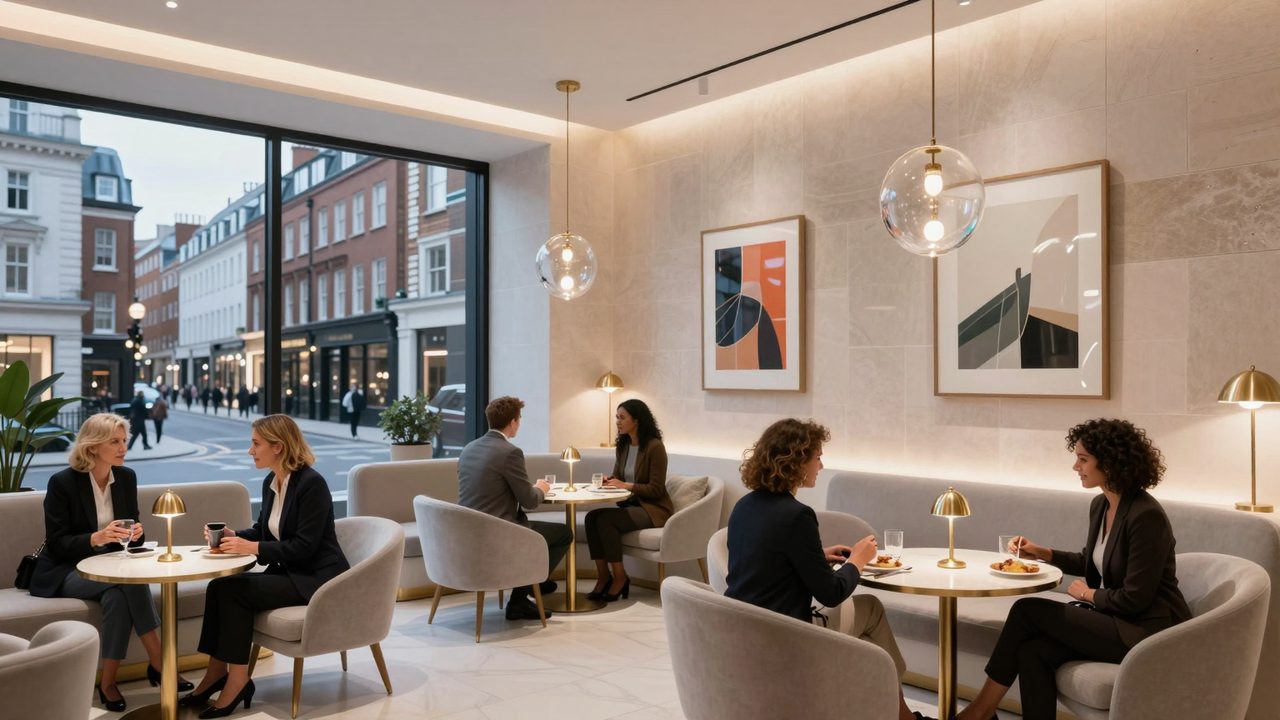
Lighting is often the difference between an interior that looks good on a rendering and one that feels right in person. A single grid of downlights can meet an illuminance target and still leave a room flat, glary and uninviting. Professional lighting design treats light as a set of layers, each with a distinct job. When these layers are combined and controlled well, they create spaces that are comfortable, functional, efficient and expressive.
Layer 1: Ambient Lighting
Ambient, or general, lighting provides the base level of illumination that lets people move around safely and see faces and surfaces comfortably.
- Typical sources: recessed or surface-mounted luminaires, linear pendants, cove lighting and indirect uplighting.
- Vertical light matters. People judge brightness largely by walls and ceilings, not the floor. Wall washing and indirect light make a space feel brighter and more open at the same or lower power.
- Uniformity: aim for even, comfortable distribution without creating a monotonous field. Some variation adds interest.
Layer 2: Task Lighting
Task lighting delivers higher illuminance where visual work happens, such as desks, kitchen counters, reception desks, workbenches and reading chairs.
- Recommended illuminance depends on the task and the users. The Illuminating Engineering Society (IES) publishes recommended practices for North America. In Europe and the UK, EN 12464-1 sets requirements for indoor workplaces. For example, it typically specifies around 500 lux for writing, typing and reading tasks in offices.
- Local task lights, such as desk lamps and under-cabinet strips, allow a lower ambient level. This saves energy and gives users control.
- Position task lighting to avoid shadows from the user's body and reflections on screens or glossy surfaces.
- Older users need significantly more light for the same task, which is an important consideration in senior living and healthcare.
Layer 3: Accent Lighting
Accent lighting creates focus and hierarchy. It draws the eye to artwork, merchandise, architectural features, textures and signage.
- Contrast is the tool. Designers often use accent-to-ambient ratios of around 3:1 for a noticeable effect, 5:1 for a strong effect and 10:1 or more for dramatic emphasis.
- Beam control: narrow-beam adjustable spots, framing projectors and track systems allow precise placement.
- Grazing and washing: lighting a textured wall from a shallow angle reveals stone, brick or timber texture. Washing from further back creates smooth, even brightness.
- Conservation: for sensitive artworks and textiles, limit illuminance and UV exposure in line with conservation guidance.
Layer 4: Decorative Lighting
Decorative luminaires, such as chandeliers, sculptural pendants, wall sconces and table lamps, are meant to be seen. They add character, scale and sparkle, and they help define zones within open spaces. Because they contribute less to functional illuminance, select them for their visual role and coordinate their brightness so that they do not cause glare at eye level.
Color Quality: CCT and Color Rendering
Correlated color temperature (CCT)
- 2700K to 3000K (warm white): residential, hospitality and restaurants.
- 3000K to 3500K: retail, many workplaces and mixed-use spaces.
- 4000K (neutral white): offices, education and healthcare treatment areas.
Keep CCT consistent within a space unless a variation is intentional. Mismatched color temperatures look like a mistake. Tunable white and warm-dim LEDs, which become warmer as they dim, extend the possibilities.
Color rendering
The Color Rendering Index (CRI, Ra) indicates how faithfully a source reveals colors. CRI 80 is a common minimum for general spaces. CRI 90 or above is recommended where color judgment matters, such as in retail, hospitality, residential, healthcare and art display. Check the R9 value for saturated reds, which affect skin tones, food and wood. ANSI/IES TM-30 offers a more detailed method (fidelity Rf and gamut Rg) that many specifiers now request.
Glare and Visual Comfort
- Choose luminaires with good shielding, deep-set sources, louvers or diffusers.
- In workplaces, the Unified Glare Rating (UGR) is commonly specified. EN 12464-1, for example, sets UGR limits such as 19 for typical office tasks.
- Avoid bright, exposed LEDs in the normal field of view, and watch reflections in glossy floors and glazing.
- Balance window brightness with interior vertical light so that faces are not silhouetted against daylight.
- Specify drivers with low flicker, especially for dimmed installations and video-call-heavy workplaces.
Controls: Making the Layers Work Together
Layers only deliver their value if users can adjust them.
- Put each layer on separate circuits or addressable channels.
- Program scenes for different uses, such as presentation, cleaning or evening dining.
- Use occupancy and vacancy sensors in intermittently used spaces.
- Use daylight harvesting to dim perimeter luminaires when daylight is available.
- Use networked controls with luminaire-level sensors in larger projects for flexibility and energy monitoring.
Energy Codes
Lighting power density limits and control requirements apply in most jurisdictions. In the US, this generally means ASHRAE/IES Standard 90.1 or the International Energy Conservation Code (IECC), with California's Title 24 being particularly stringent. In the UK, Part L of the Building Regulations applies. Layered lighting with good controls usually makes code compliance easier, because each layer works only when and where it is needed.
A Simple Layering Process
- Understand the activities, users and mood for each space.
- Set targets for illuminance, CCT, CRI and glare.
- Design the ambient layer, emphasizing vertical surfaces.
- Add task lighting where visual work happens.
- Add accent lighting to create hierarchy and focus.
- Select decorative luminaires that suit the interior concept.
- Coordinate with ceilings, furniture, MEP services and controls.
- Check compliance and calculate results, then mock up critical details where possible.
To build lighting specification skills alongside materials and FF&E selection, consider the IACEA course Interior Materials, Lighting and FF&E Specification.